A question came up twice today, from opposite sides. Matthew Kratter’s video this afternoon walks through an explorer block by block, finds a block tagged “CEO of LukeCoin” paying the same address as AlphaPool’s, and says “a number of these other pools, if you go through and look at it, are associated with Alpha Pool.” Mining Stacker’s video this morning says the AlphaPool fight is “a distraction to the fact that China runs this network.” Both claims are about who is behind which blocks. Our node cannot see who. It can see every coinbase, every payout address, and where every mined coin went. So we asked it the narrower question that has an answer: how many payout addresses does AlphaPool’s wallet control, and how much of the chain is that?
Method
Everything below comes from one Bitcoin Knots node on a desk, over RPC, on September 13. No explorer, no pool’s own statistics.
- Every coinbase since activation. Blocks 961,640 to 971,931, 10,292 blocks, 57,440 payout outputs. For each: the payout addresses, the amounts, the coinbase tag, and whether the output has been spent (
gettxout). - Every spend of a coinbase output since the fourth retarget. Every transaction in blocks 969,696 to 971,931, checked for inputs that are coinbase outputs from step 1. 20,471 such spends, in a few thousand transactions.
- The common-input rule. If one transaction spends coinbase outputs paid to two different addresses, one wallet controls both. This is the oldest heuristic in chain analysis and it has one known false positive: an exchange sweeping deposits from many customers into one transaction also merges strangers. We checked for that by looking at the input counts and tags of every merging transaction.
- The destination rule, weaker. Where the coins go after the coinbase is spent.
We ran step 3 on every payout address on the chain, not just AlphaPool’s, so the known cases could check the method. Bitcoin Xor pays to several addresses and they came out as one cluster. Lazarus pays to several addresses and they came out as one cluster, with a caveat that is itself a finding, below.
What the node says about AlphaPool
One address. Every block we attribute to AlphaPool pays bc1qlrmjpgg0…8vjl2q, one output, the whole reward. 1,740 blocks since its first on September 1 at 22:53 UTC.
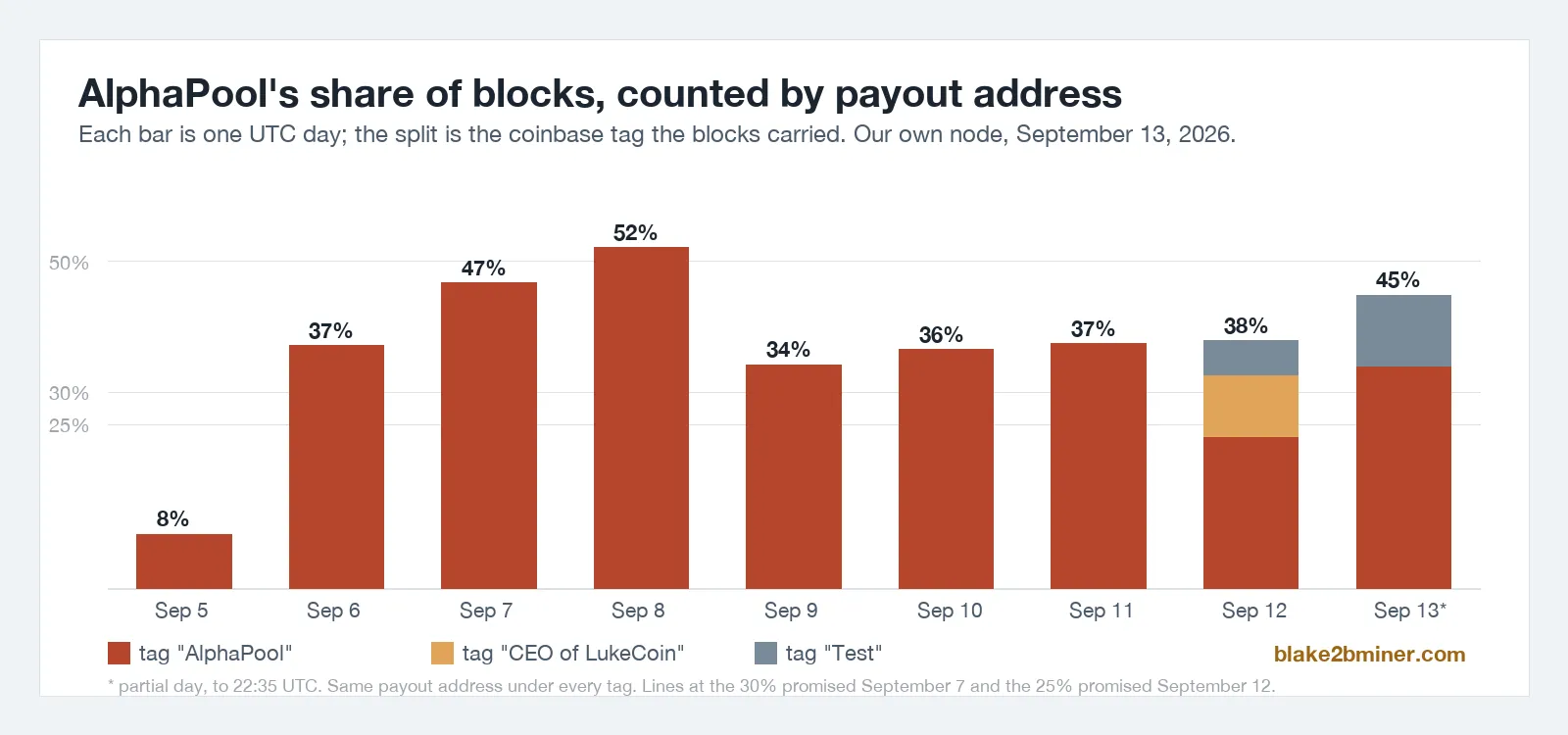
Three tags on it. 1,656 blocks carry “AlphaPool AlphaPool.” 42 carry “CEO of LukeCoin CEO of LukeCoin,” all between 01:27 and 07:23 UTC on September 12, the morning before the operator’s post that morning about “the CEO of Lukecoin.” 42 carry “Test Test,” 23 on September 12 and 19 today. The doubled word is not a signature of anything; it is how DATUM Gateway writes a coinbase, and dozens of solo miners’ blocks read the same way (“Kilombino Kilombino,” “connorslab connorslab”). Kratter’s tag hunt is right on the fact and understates the count: the explorer he reads lists “CEO of LukeCoin” as its own pool, so those 84 blocks fall out of AlphaPool’s row there, and since the cap the row reads about four points low. We count by address, so every number this site has published for AlphaPool already included them.
No other addresses. AlphaPool’s coinbase outputs have been spent in 465 transactions since the fourth retarget. Not one of those transactions spends a coinbase output paid to any other address. By the common-input rule, the wallet that holds AlphaPool’s rewards holds no other pool’s rewards. If the operator runs a second pool under a second address, its coins never touch these. That is as far as a node can see, and it is exactly as far as an explorer can see.
The DATUM side. 14 blocks carry an AlphaPool tag but pay someone else, most to one address with ten to thirty outputs, tagged “AlphaPool Tides” or “DATUM-AlphaPool,” September 7 to 11. That is what a DATUM block looks like: the miner built it, the pool’s name is on it, and the miner is paid directly inside the coinbase. Whoever chose to point DATUM at AlphaPool found those blocks. They are in the explorer’s AlphaPool row; they are not in ours, and they are 0.7 percent of the pool’s count.
Who it pays. The 465 spends are payout batches: seventy to a hundred outputs each, to 951 distinct addresses in all, 3,426 XBT. Twenty-five addresses appear in almost every batch. The largest single destination received 4.2 percent of the total, the top ten 31 percent, the top twenty 47 percent. Each coinbase is spent at a median age of 102 blocks, two past maturity; 94 percent are spent by block 110. A pool that pays about 950 addresses on the hour is not one operator with one farm. What it is beyond that, addresses cannot say.
The share, as of 22:35 UTC. Since its cap took effect on September 8: 752 of 2,003 blocks, 37.5 percent. Since the operator’s 25 percent post on September 12 at 14:29 UTC: 119 of 293, 40.6 percent. The last 180 blocks: 45 percent. A day of 180 blocks has a luck band of about four points, so one high day is a lean and not a verdict; a week above 34 is not luck.
What the node says about the rest
The Lazarus cluster is the one to read carefully. Its two main payout addresses merge, as expected. But the same transactions also pull in coins first paid to Bitcoin Xor’s addresses and to a PyBLOCK address, and the merging transactions have thirty to a hundred inputs. That is not one pool owning three. It is the shape of a DATUM chain: pools that pay miners directly inside the coinbase produce hundreds of small outputs to miners’ own addresses, and a miner who moved from Xor to Lazarus spends both together. Address clustering on this chain finds miners, not pools, whenever the pool speaks DATUM. That is a property of the design, and it is worth knowing before anyone reads a cluster as a conspiracy.
On the wider claim, that one country holds 80 percent of the hash: a node sees payout scripts and coinbase text, never a location. The ping tables on rental sites and the pool lists on explorers are the only public proxies, and neither measures a country. We are not able to check that number and we have not seen anyone who can.
Why we did this
The lock being argued in the Knots room is a rule that cannot see anyone either. It reaches every coinbase alike. So the useful question was never who the operator is. It was whether the chain’s biggest pool is one address or ten, whether its coins go to one wallet or a thousand, and whether the tag on a block is the pool. One, about a thousand, and no. Anyone with a node can repeat the count; the method is above, and the ledger it runs on is a forty-second pull.
Same rules as always: the count is a payout statistic, an address is not a person, and nothing here says what anyone intends. AlphaPool’s operator has said what he intends. The node says what happened.
Saved you an hour? Tip the node and the clankers.