Mining Stacker, in his video of September 13 at 16:30: “if you didn’t come out with at least two to five hundred coins, you got rugged by your own people.” That is a claim about a window of time and about who got how much in it. Our node can answer both, up to the point where an address stops being a person. This post is that answer, with its limits stated.
The window, as the data draws it
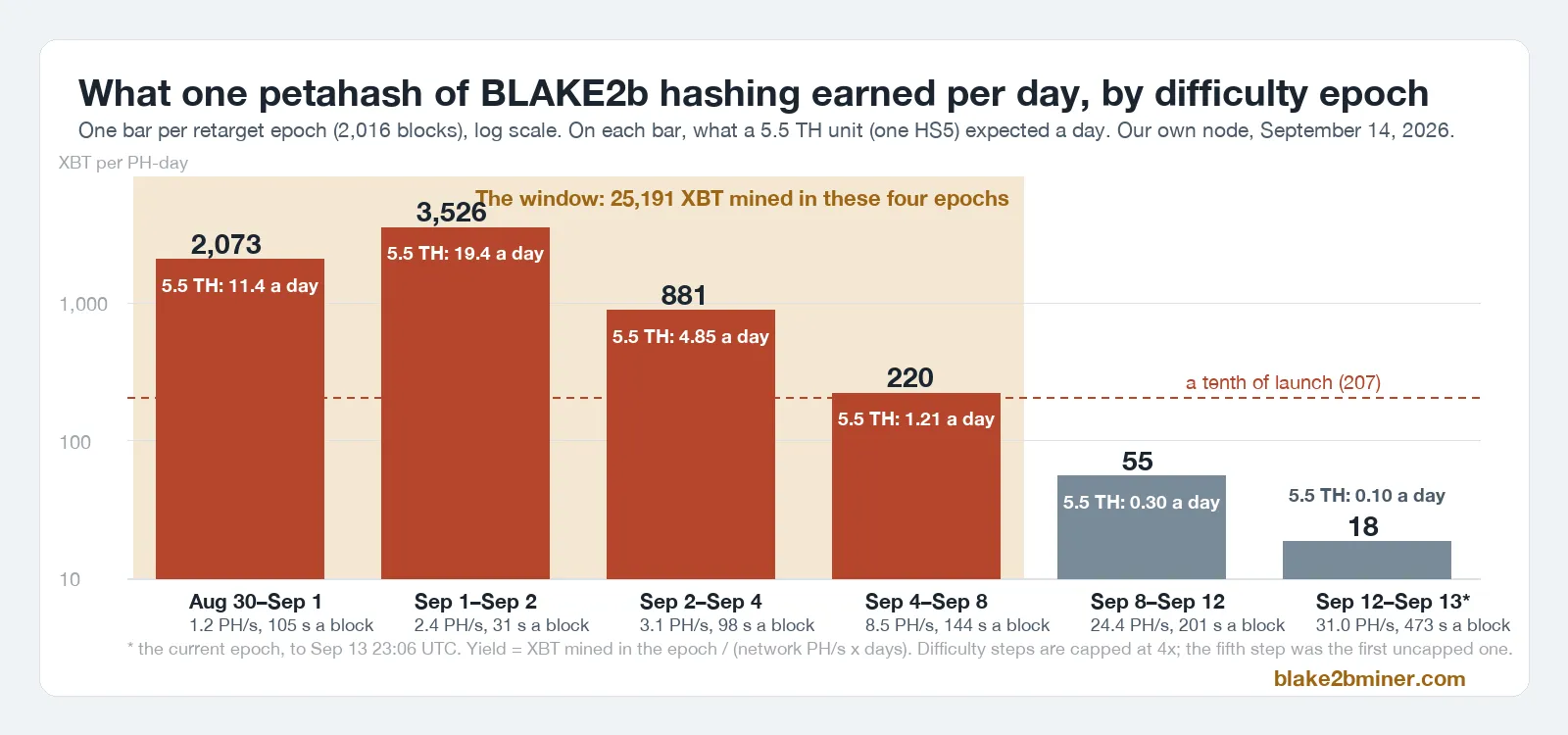
The chain retargets every 2,016 blocks and each step is capped at 4x. What a miner earns per unit of hash is the coin mined in an epoch divided by the hash that mined it. Per petahash-day, from our node:
| Epoch | Span (UTC) | Blocks | s/block | PH/s | XBT per PH-day | 5.5 TH a day |
|---|---|---|---|---|---|---|
| 961,640 to 963,647 | Aug 30 06:14 to Sep 1 16:33 | 2,008 | 105 | 1.25 | 2,073 | 11.4 |
| 963,648 to 965,663 | Sep 1 16:33 to Sep 2 10:05 | 2,016 | 31 | 2.45 | 3,526 | 19.4 |
| 965,664 to 967,679 | Sep 2 10:05 to Sep 4 16:40 | 2,016 | 98 | 3.14 | 881 | 4.85 |
| 967,680 to 969,695 | Sep 4 16:46 to Sep 8 01:26 | 2,016 | 144 | 8.51 | 220 | 1.21 |
| 969,696 to 971,711 | Sep 8 01:46 to Sep 12 18:03 | 2,016 | 201 | 24.45 | 55 | 0.30 |
| 971,712 on | Sep 12 18:04 to Sep 13 23:06 | 222 | 473 | 31.02 | 18 | 0.10 |
The last column is one HS5, a 5.5 TH unit, with average luck. The second epoch is the best day anyone will have on this chain: the launch difficulty was set above the hash that showed up, the first retarget cut it 41 percent, and for seventeen hours blocks came every 31 seconds. After the fourth retarget the yield was a tenth of launch. Today it is under one percent.
We take activation to that fourth retarget as the window: blocks 961,640 to 969,695, 8,056 blocks in 8.8 days, at a network average of 4.6 PH/s. One HS5 running the whole window expected about 57 XBT. Two hundred coins took the hash of about four of them from the first hour; five hundred took nine.
Who got them
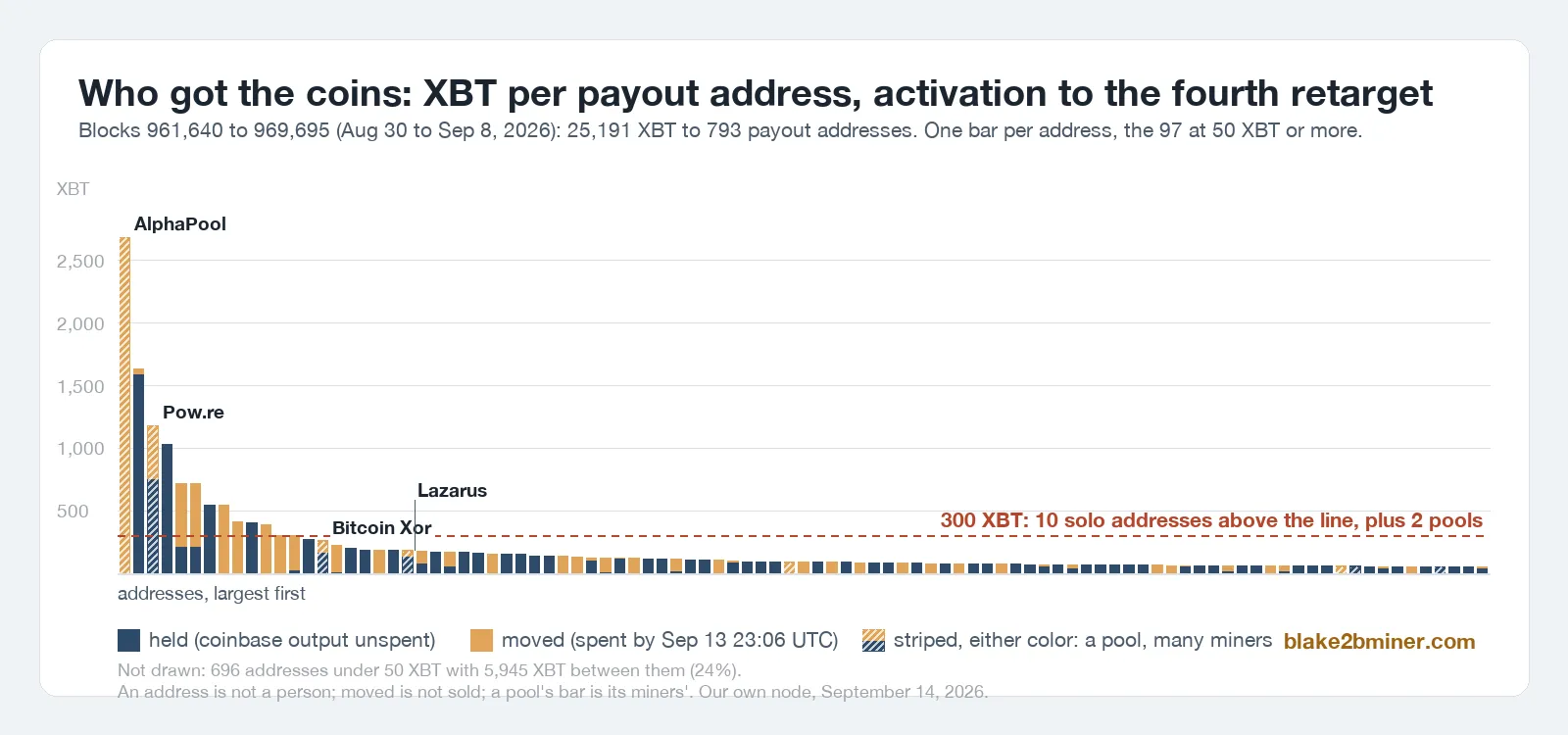
25,191 XBT went to 793 payout addresses.
| Coins per address | Addresses | XBT | Share | Moved by Sep 13 |
|---|---|---|---|---|
| under 10 | 504 | 1,474 | 5.9% | 33% |
| 10 to 50 | 192 | 4,471 | 17.8% | 33% |
| 50 to 100 | 54 | 3,702 | 14.7% | 29% |
| 100 to 300 | 31 | 4,986 | 19.8% | 38% |
| 300 to 1,000 | 8 | 4,030 | 16.0% | 66% |
| over 1,000 | 4 | 6,528 | 25.9% | 48% |
Two of every three addresses got under ten coins. Forty-three got 100 or more, seventeen got 200 or more, twelve got 300 or more. The largest address took 10.7 percent, the top ten 39 percent, the top twenty 49 percent.
The largest address is a pool, and that changes how the table reads. A pool address is many miners. AlphaPool’s one address took 2,685 XBT, and the last post showed it paying about 950 addresses on the hour its coins mature. Pow.re’s one address took 1,182. Bitcoin Xor, Lazarus, CONVOY, B2Pool and PyBLOCK’s fee address account for the rest of the 36 addresses we label as pools by their coinbase tags: 5,022 XBT between them, a fifth of the window. PyBLOCK’s blocks pay the finder and take a fee, so its miners are counted as the miners they are; the rule is in the method below.
“Moved” means the coinbase output has been spent as of September 13, 23:06 UTC. Across the window it is 42.6 percent. A pool’s moved coins are its payouts.
The twelve over the line
Every address that crossed 300 XBT in the window, the tag as written on its blocks:
| XBT | Blocks | Moved | Coinbase tag | |
|---|---|---|---|---|
| 2,685 | 859 | 100% | AlphaPool AlphaPool | pool |
| 1,632 | 522 | 2% | mycology anastomosing | |
| 1,182 | 378 | 36% | Pow.re buy hashrate @ pow.re | pool |
| 1,029 | 329 | 0% | Knots | |
| 719 | 230 | 70% | .Unto the pure all things are pure. Titu… | |
| 719 | 230 | 70% | PLACEHOLDER | |
| 544 | 174 | 0% | (blank) | |
| 541 | 173 | 100% | DATUM Gateway leonx13yoga | |
| 413 | 132 | 100% | /blake2b-mainnet 8-30 NYPost Deride And… | |
| 403 | 129 | 0% | (blank) | |
| 388 | 124 | 100% | PLACEHOLDER | |
| 304 | 98 | 100% | PyBLOCK-LOTTO-BLAKE2b | finder in a lotto pool |
Every one of these was paid whole blocks, one output each. No pool paid any of them inside its coinbase.
The twelve, in full, in the table’s order. Paste any of them into an explorer of your choice, or into your own node; the count is the same either way.
bc1qlrmjpgg0e5jrhmzyjmtgc6dfpdr66sps8vjl2qbc1qjeu7ku7l7szqee3qzdf7resf30d3lzaxetkflp3QvtQ9wKyfp22Z9anPUoHKBuCew4kdcAZtbc1qfpnrnu89cnzjyka83575gcsduen0k2074ulmkj30mul5mcw8pg6spuedgvbc1qphy8wnl9jcpdmxjzwm07pqn8r0kv60sr277uvv1MhBd9HwVJH5tAuurRtrm4tDtFGBZo8SkBbc1qtqgv37fmjvuma8jes75qt8ns0sudukghtz69q8bc1qky9tqqst2g0g7xd6v9smaxfpz3qamwqn93jeppbc1qx37cu2rrw4kk4wguvuyzv7pruzf347ey9zmhh6bc1qqn793sjcylkd8tgqencvy860278was0pzj8hfhbc1qrujdm2999effwvzleg93y6ykjfazxagfg6sy2w1By8prQMbUciuccQuRFBsyeqFUmbudM1Cd
The spend pattern among the ten solo addresses is the finding. Four have moved nothing, or almost nothing: 1,632, 1,029, 544 and 403 XBT sitting where they were mined. Four have moved all of it. The two at 719 have the same 230 blocks each and the same 70 percent moved, which reads as one setup paying two addresses in turn. There is nothing in between: no address in this group has moved a third, or half. Together the ten hold 4,000 of their 6,691 XBT.
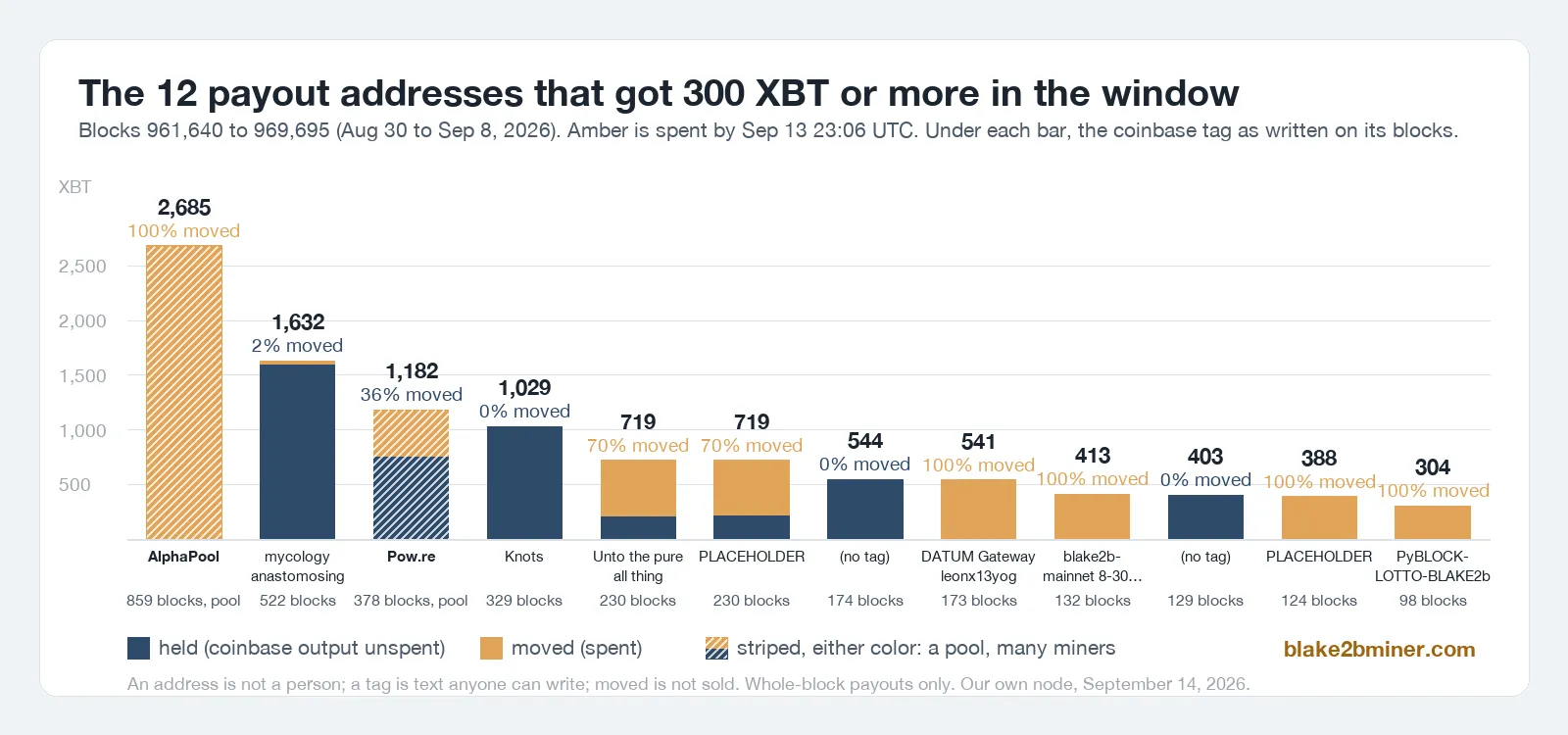
On the tags: “8-30 NYPost Deride And Conquer” is the chain’s activation headline, the New York Post’s for August 30, which the first block had to carry the way bitcoin’s first block carried the Times, and which DATUM kept as its default tag afterward. It appears on blocks from dozens of unrelated addresses, so it is the software’s text, not a miner’s name. “PLACEHOLDER” and a blank say what they say. A tag is text anyone can write, and two of the twelve wrote nothing.
What the numbers say, and what they cannot
On the claim itself. The window was real, and it was short: the yield per hash on September 8 was a tenth of what it was on August 30. Two to five hundred coins in that window took four to nine HS5s of hash from the first hour, or more if the hash arrived later. Twelve of 793 payout addresses got there, and two of those are pools whose totals belong to hundreds of miners. Two out of three addresses got fewer than ten coins. Whether that is a rug depends on what anyone was promised, and the chain does not record promises.
On what the coins did. Among the addresses that crossed the line, the ones that held have held everything, and the ones that moved have moved everything. The node can see that. It cannot see why. Moved is not sold: a spend can be a pool paying its miners, a wallet consolidating, or coins going to cold storage, and it looks the same in every case.
On who. An address is not a person. One person can hold several, as the pair at 719 suggests, and a pool holds one for many. The node sees what each address was paid, never what it ran. Nothing here names anyone, and the tags, which anyone can write, name only what their writers chose to put there. Kratter traced a tag across an explorer on September 13 and found the same address under two names; the tags in this table are worth exactly that much.
September 15. Mining Stacker’s results video reads this post on screen and puts his own two-week numbers beside it. They are in the mercenary post, under September 15.
Method
One Bitcoin Knots node over RPC. tools/coinbase-ledger.py pulls every coinbase since activation with each output’s address, value and spent status, about thirty seconds. tools/extraction-window.py builds the epoch table from block times and difficulty, sums the window by payout address, and labels pools by tag: a pool that collects whole blocks to one address (AlphaPool, Pow.re, CONVOY, B2Pool) is that address; a pool that pays inside the coinbase (PyBLOCK, Bitcoin Xor, Lazarus) is the address that recurs in most of its blocks, and Bitcoin Xor’s finder addresses count as the pool because they spend from one wallet. The three cards render from the same JSON. Anyone with a node can repeat the count.
Saved you an hour? Tip the node and the clankers.